What trading confluences actually matter when you combine liquidity, fair value gaps and structure?
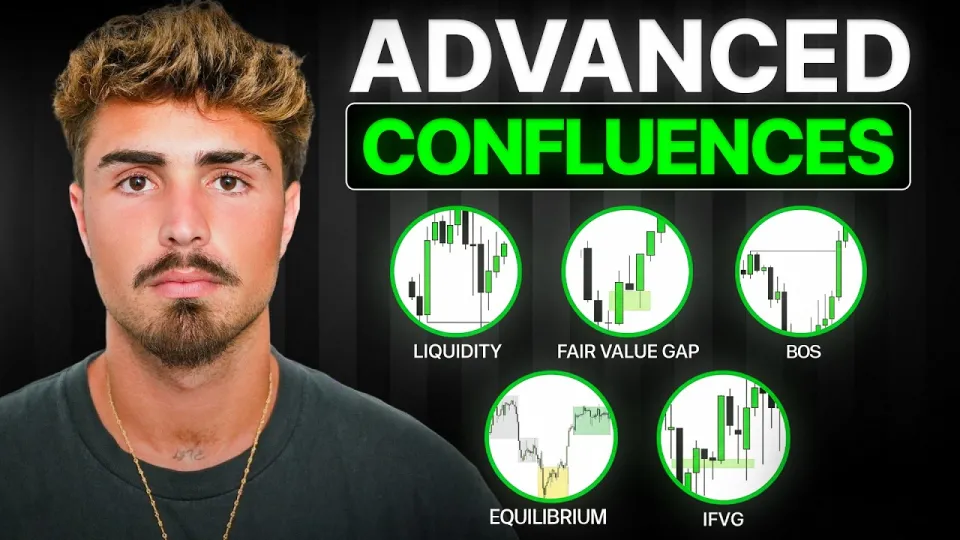
Video: Learn Every Trading Confluence In 18 Minutes
Want articles like this for your own video to promote it on YouTube and Google? Order them through the Telegram bot @sat_sit_bot. The bot writes and publishes the articles itself (with your YouTube video embedded) on popular topical websites (no ads). Your first 50 articles are free.
· based on the channel TJR
Trading confluences are independent signals that line up on the same chart area — a liquidity sweep, an unfilled fair value gap and a break of structure pointing the same way — and they matter because they let you trade a level for several reasons instead of one. The practical rule is to require at least two or three of them before risking money, and to skip setups where only a single condition fires. TJR's breakdown of the main confluence types in 18 minutes is a useful checklist, and the same framework is what the full training behind the TJR blueprint is built on.
What a trading confluence is and why stacking signals changes the odds
A trading confluence is a point on the chart where two or more unrelated analytical tools agree, so the probability of a reaction is higher than with either tool alone. Price action, liquidity, imbalance and market structure are separate lenses: structure tells you the direction, liquidity tells you where stops sit, and imbalance tells you where price moved too fast to trade fairly. When all three agree on one zone, you have a confluence.
The trap is treating confluence as a numbers game. Five weak signals do not equal one strong one, and the most-liked comment under the video makes the point plainly: the skill is knowing which confluences actually add value to your strategy. A useful filter is to ask whether each condition would still make you take the trade if the others were absent. If the answer is no for all of them, you have a confirmation stack, not an edge.
The five confluences covered in the 18-minute breakdown
The video walks through five building blocks that cover most of what a discretionary intraday trader needs. Each one answers a different question, which is exactly why they combine well.
- Liquidity. Clusters of stop orders above equal highs or below equal lows. Price is drawn to them because that is where resting orders can be filled.
- Fair value gap (FVG). A three-candle imbalance where the wick of the first candle and the wick of the third do not overlap, leaving a gap in the middle candle's range. It marks an area where price moved without two-sided trade.
- Inverse FVG. An FVG that failed to hold and flipped its role — a former support gap now acting as resistance, or the reverse.
- Equal highs and equal lows. Two or more highs or lows at nearly the same price; a visible liquidity pool and a magnet for price.
- Break of structure (BOS). A close beyond the most recent swing high or low that confirms the current leg of the trend and shifts the bias.
None of these is a signal by itself. An FVG in the middle of nowhere is noise; an FVG sitting behind a swept low, in the direction of a fresh BOS, is a setup.
How to combine liquidity, fair value gaps and structure step by step
Combining the confluences works best as a fixed sequence, because the order stops you from forcing a narrative onto a chart. A workable routine looks like this:
- Mark the higher-timeframe bias using the last break of structure. If the last BOS is bullish, you look for longs only.
- Mark equal highs and equal lows, plus any obvious swing points, as liquidity targets.
- Wait for a sweep of that liquidity against the bias — a wick through the level that closes back inside.
- Drop to the lower timeframe and find the FVG created by the displacement leg that caused the sweep.
- Enter on the retrace into that gap, with the stop beyond the sweep wick and the target at the next liquidity pool.
The sequence matters more than the individual pieces. A sweep without displacement is often just a stop run before continuation in the original direction; displacement without a gap leaves you no defined entry. When the sweep, the gap and the structure agree, the trade has a clear invalidation point, which is what makes risk definable.
Where inverse fair value gaps and equal highs fit in practice
An inverse FVG is the most misread of the five, and it is best treated as evidence of a failed move rather than a fresh signal. If price trades back through a fair value gap and closes beyond it, that gap has been violated; the same zone frequently becomes the level where the next retest stalls. In a bullish context, a gap that held as support and then broke becomes resistance on the retest — the mirror image of the original setup.
Equal highs and equal lows serve a different purpose: they are targets, not entries. Retail traders read a double top as resistance; a liquidity-based reading treats it as a pool of stops that price may run before continuing. That is why the level is useful for placing take-profits and for anticipating a fake breakout, and why entering exactly at the equal highs is usually the worst version of the trade.
Common questions traders raise about confluence trading
Most of the pushback on confluence trading is about survival and expectations rather than the concepts. A recurring theme in the comments is that losing money early is close to unavoidable, and that the traders who last are the ones who keep showing up rather than chasing a fast result. Confluence trading does not remove that phase; it shortens it by giving you a rule for when not to trade.
Another frequent doubt is manipulation. Markets do run stops, and the liquidity concept explains the mechanism without requiring a conspiracy: clusters of orders are simply where size can be filled. The practical response is to stop placing stops at obvious swing points and to treat sweeps as information instead of betrayal.
A third theme is time. An 18-minute explainer can be rewatched in an hour with notes, but knowing the five confluences and executing them under pressure are different skills. Journaling every setup — which confluences were present, whether you followed the sequence — turns the checklist into data you can actually evaluate.
Useful links
- TJR blueprint — the full system for becoming a consistently profitable trader
- Indicators TJR uses daily
- Funded account raffle entry
- Alpha Futures funded accounts — 10% off
- Lucid Trading — 40% off
The bottom line on building a confluence checklist
Confluence trading works because it forces you to wait for a location where structure, liquidity and imbalance agree, and that location comes with a natural invalidation point. The five tools TJR covers — liquidity, fair value gaps, inverse FVGs, equal highs and lows, and break of structure — are enough to describe most intraday setups without adding indicators. Pick two or three that you can mark in under a minute, require all of them before entry, and track the results before adding anything else. If you want the full framework rather than the summary, start with the TJR blueprint, and treat the channel's 18-minute breakdown as the map rather than the territory. Day trading is risky and most day traders lose money, so size positions as if every edge is provisional.
Key takeaways
- Confluence means stacking independent signals — liquidity, imbalance and structure — so one setup carries several reasons, not one.
- The core set covered in TJR's 18-minute breakdown: liquidity, fair value gap (FVG), inverse FVG, equal highs/lows and break of structure (BOS).
- A fair value gap is a three-candle imbalance; it matters as a reaction zone, not as a signal on its own.
- An inverse FVG is a failed FVG that flips role — the level that held as support becomes resistance after a break.
- Equal highs or lows are liquidity pools; price often sweeps them before continuing, which is why they are watched as targets, not entries.
- More confluences is not automatically better: each added condition cuts trade frequency and can turn a clean setup into curve-fitting.
Source: Learn Every Trading Confluence In 18 Minutes · Markdown version
Questions & answers
How many confluences should a trade have?
Two or three independent ones are usually enough: a liquidity sweep, a fair value gap and a structural break in the same direction. Adding more conditions cuts the number of trades sharply and often just fits the strategy to past charts. The test is whether each condition would make you skip the trade if it were missing.
What is the difference between a fair value gap and an inverse fair value gap?
A fair value gap is a three-candle imbalance where the first and third candles' wicks do not overlap, marking a zone price moved through quickly. An inverse FVG is that same zone after price has closed through it and violated it, so it flips role — former support becomes resistance, or the reverse — and is watched on the retest.
Do I need indicators to trade confluences?
No. Liquidity levels, fair value gaps, equal highs and lows, and breaks of structure can all be marked from a clean candlestick chart. Indicators can speed up marking, but they do not create the confluence; the agreement between structure, liquidity and imbalance does.
Why do most traders still lose money even when they know these concepts?
Knowing the checklist and executing it under pressure are separate skills, and early losses are close to unavoidable while you build screen time. Traders who last tend to follow a fixed sequence, journal every setup and keep position size small enough to survive the learning phase. Social media highlights the outcome and hides that process.